Free worksheets / First grade math / Addition, Subtraction & Word Problems
First grade addition, subtraction & word problems worksheets
Addition and subtraction worksheets for first grade: count on, make a ten, doubles, fact families, missing addends and word problems within 20. Every set has color and black & white pages and an answer key, so they work for centers, morning work and homework.
7 sets · every set has a free sample to print today
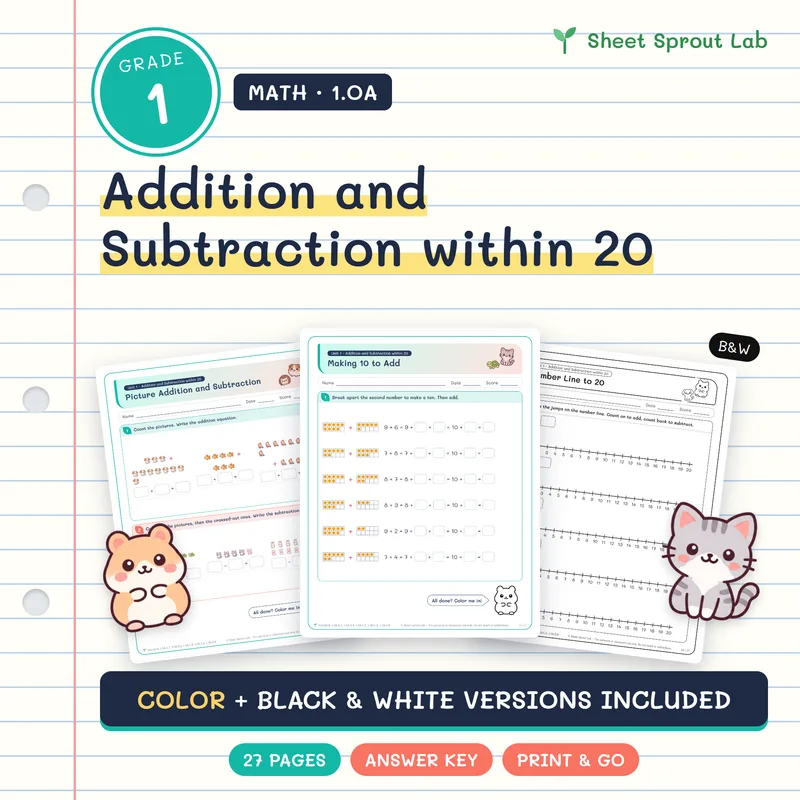
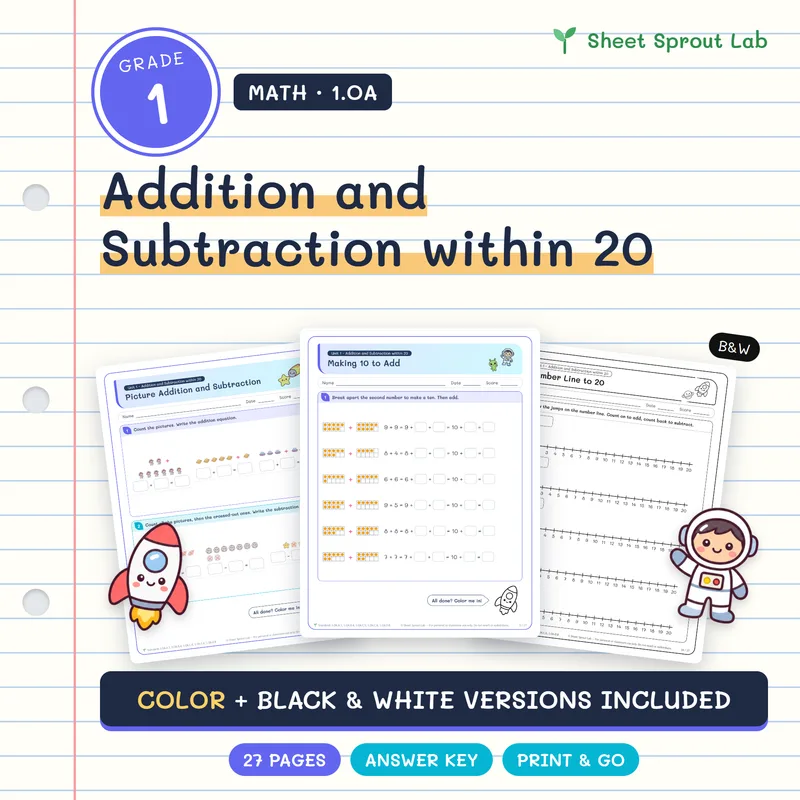
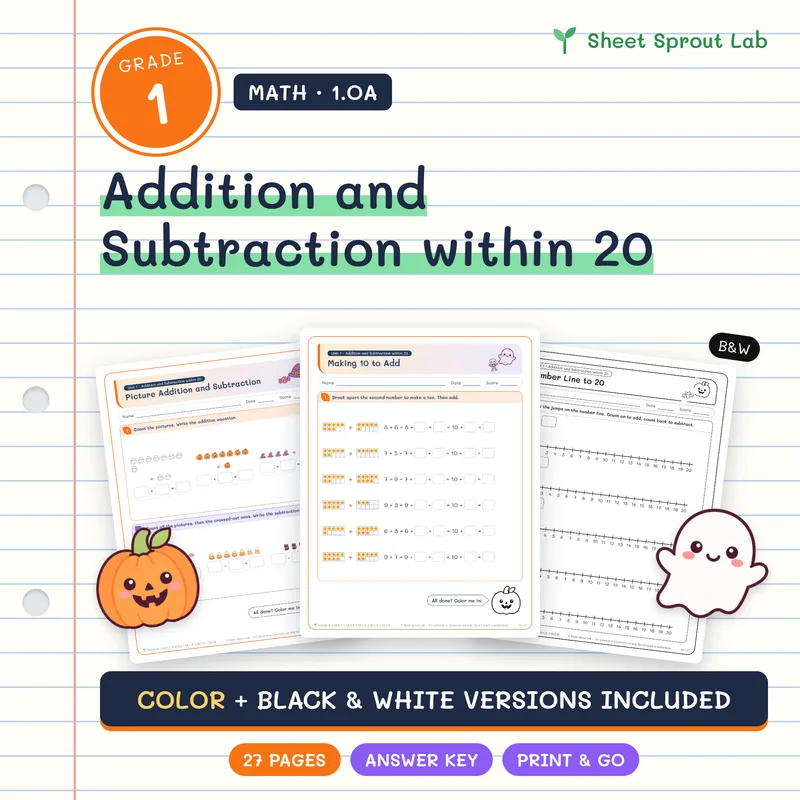
Addition and subtraction in first grade
This is the big one for first grade. Kids learn to add and subtract within 20 — not by memorizing a long list, but by using strategies that build number sense: counting on, making a ten, using doubles and near doubles, and seeing how addition and subtraction are related through fact families.
Word problems matter just as much as the facts. First graders solve stories where something is added, taken away, put together or compared — and the missing number can be anywhere in the equation, like 8 + ? = 13.
Skills kids practice
- Count on from the bigger number (1.OA.C.5)
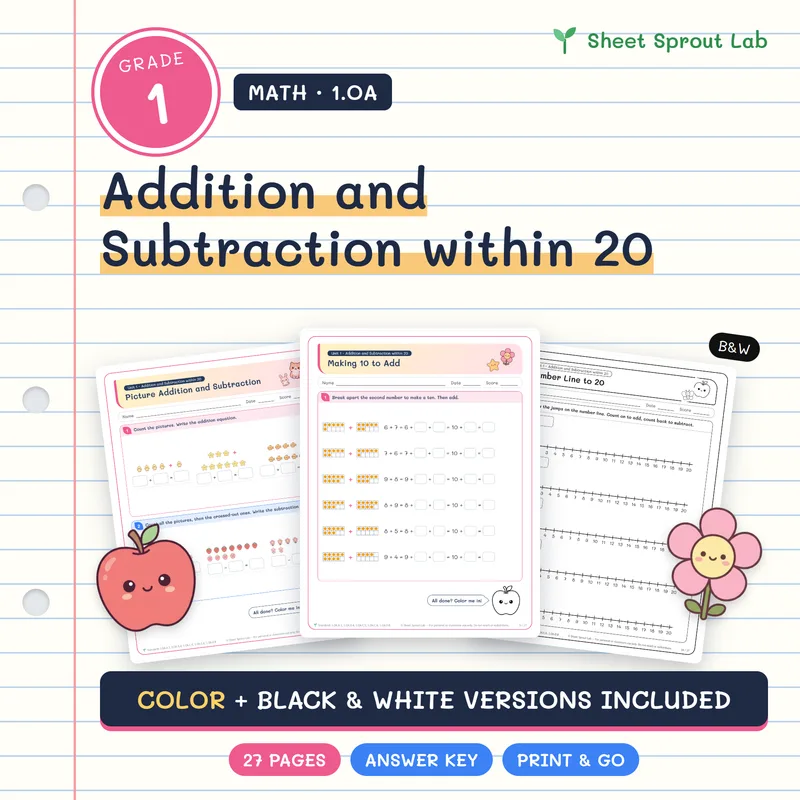
- Make a ten: 8 + 5 = 8 + 2 + 3 = 13 (1.OA.C.6)
- Doubles and doubles plus one: 6 + 7 = 6 + 6 + 1
- Fact families and missing addends (1.OA.B.4, 1.OA.D.8)
- Word problems within 20 with the unknown in any position (1.OA.A.1)
- Fluency with facts within 10
Tips for teachers and parents
- Start each session with a quick reference: a ten frame or number line on the table helps kids see the strategy.
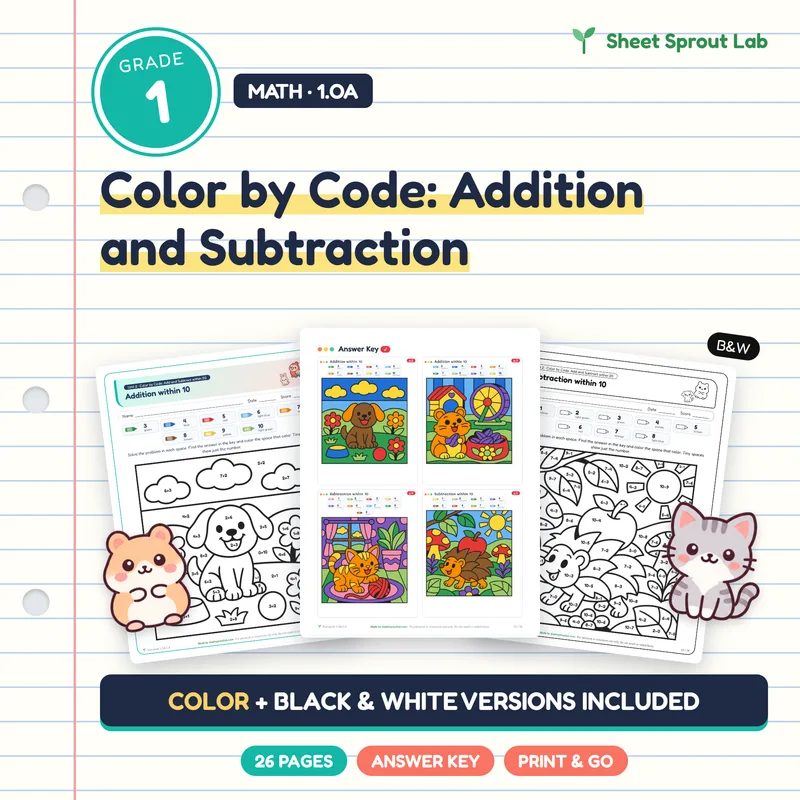
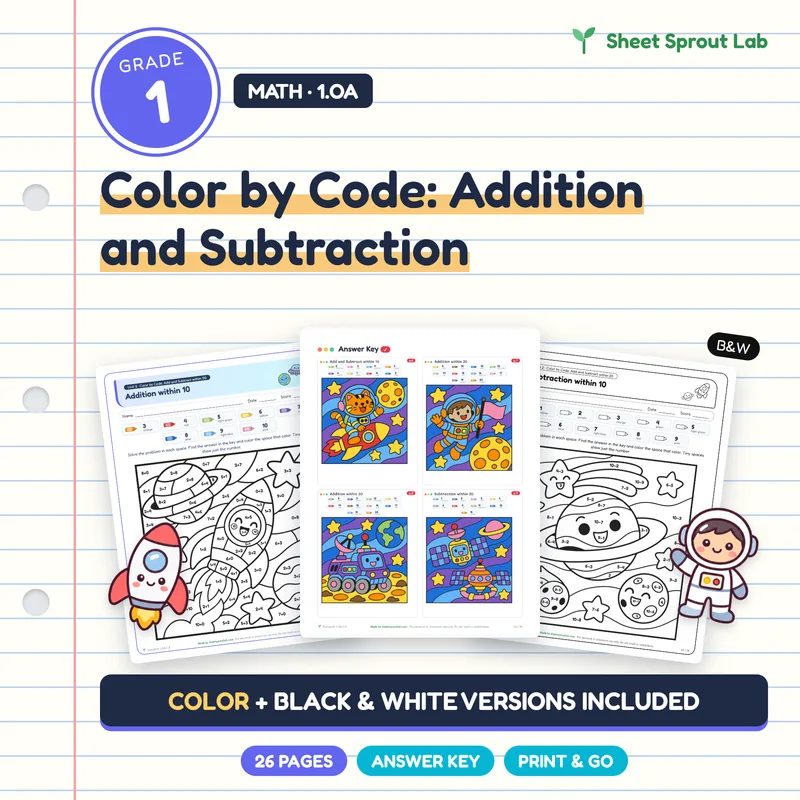
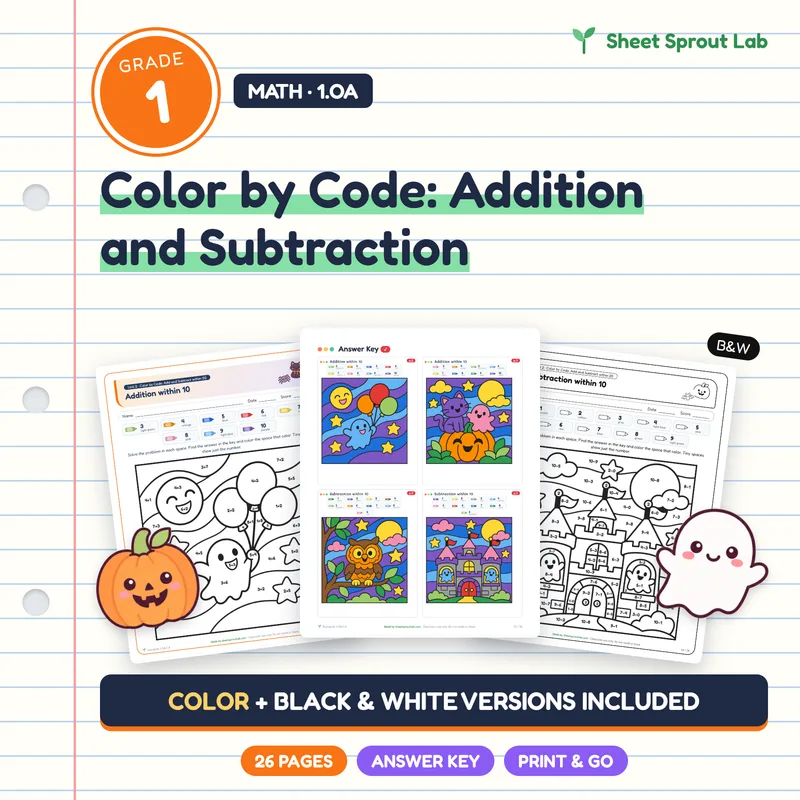
- Color by code pages are a great self-check — if the picture looks wrong, an answer is wrong.
- Read word problems aloud for kids who are still learning to read; the goal is the math, not the decoding.
Questions about addition, subtraction & word problems worksheets
What is the "make a ten" strategy?
Kids break apart one number to fill a ten first. For 8 + 5, they move 2 from the 5 to make 10, then add the 3 that is left: 10 + 3 = 13.
Should first graders memorize their math facts?
The Common Core expects fluency within 10 by the end of first grade. Facts to 20 come from strategies like making a ten and doubles, which is why our worksheets practice the strategy, not just the answer.
How do I help a child who counts on their fingers?
Finger counting is fine — it is a step toward mental math. Encourage counting on from the bigger number, then move to ten frames and make-a-ten practice.
Standards covered
- 1.OA.A.1 Use addition and subtraction within 20 to solve word problems involving situations of adding to, taking from, putting together, taking apart, and comparing, with unknowns in all positions.
- 1.OA.B.4 Understand subtraction as an unknown-addend problem.
- 1.OA.C.5 Relate counting to addition and subtraction (e.g., by counting on 2 to add 2).
- 1.OA.C.6 Add and subtract within 20, demonstrating fluency for addition and subtraction within 10. Use strategies such as counting on; making ten; decomposing a number leading to a ten; using the relationship between addition and subtraction; and creating equivalent but easier or known sums (e.g., doubles plus one).
- 1.OA.D.8 Determine the unknown whole number in an addition or subtraction equation relating three whole numbers.