Free worksheets / First grade math / Place Value & Hundreds Chart
First grade place value & hundreds chart worksheets
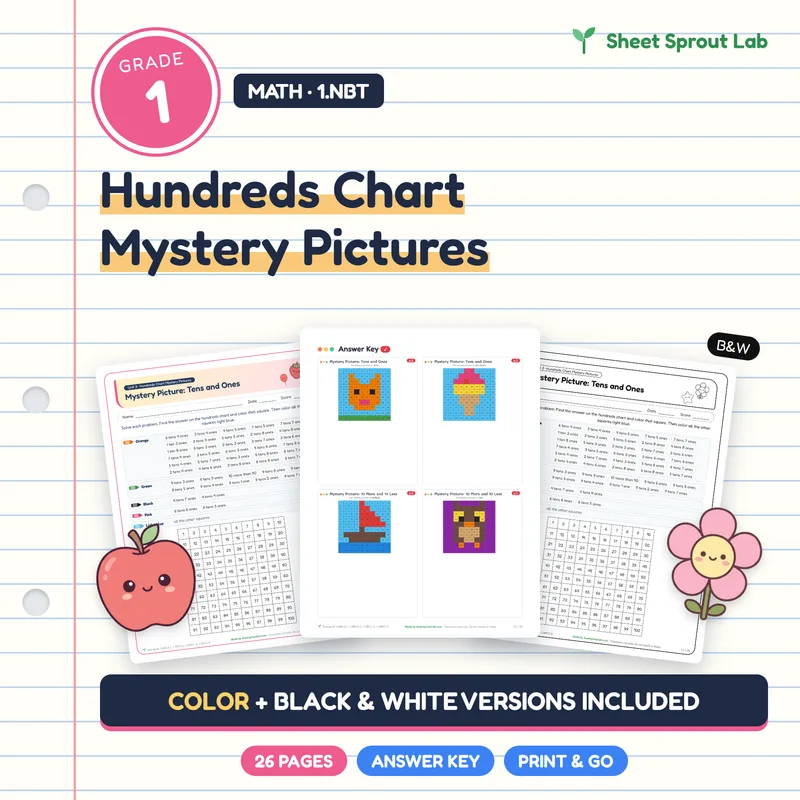
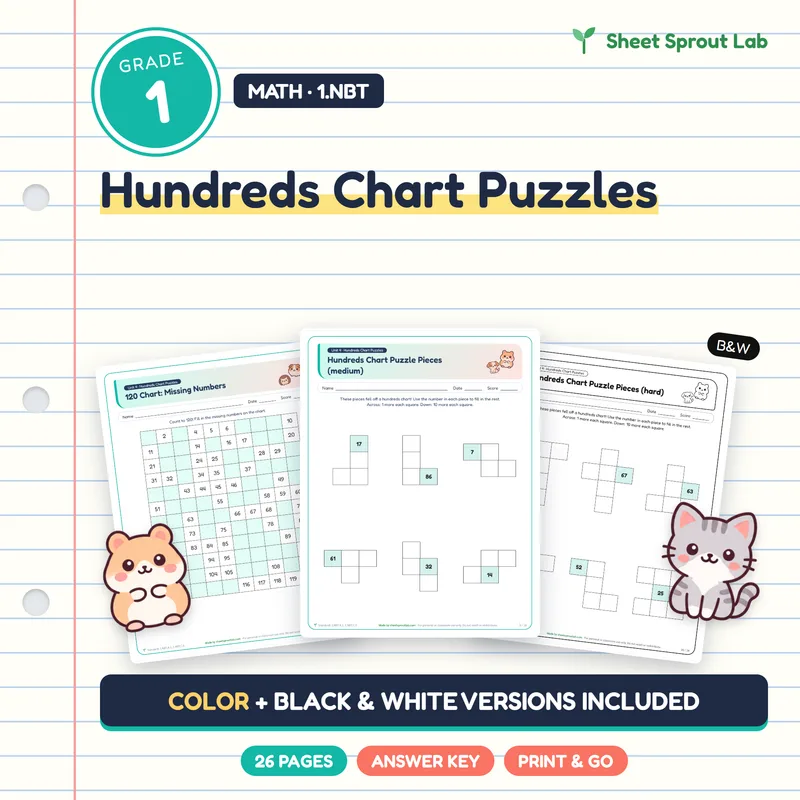
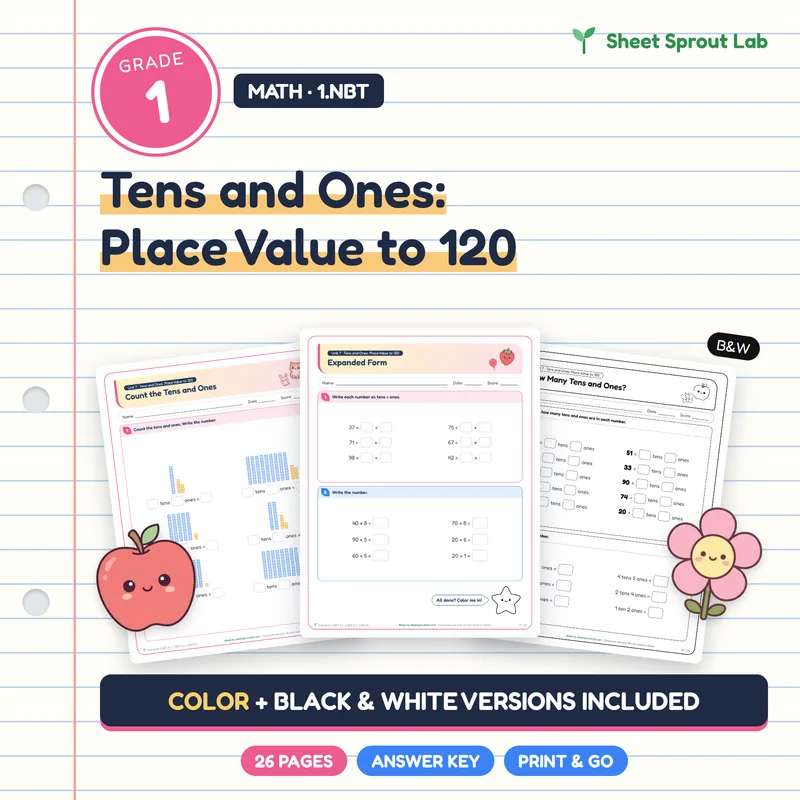
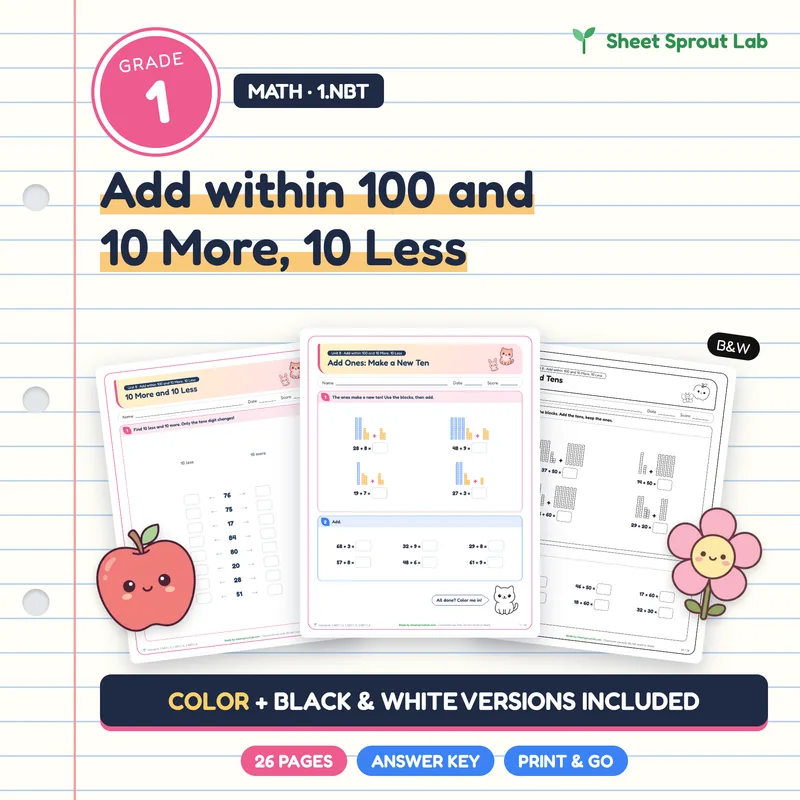
Place value and hundreds chart worksheets: count to 120, find 10 more and 10 less, and see how tens and ones build a number. Mystery pictures and puzzles make the practice feel like a game.
4 sets · every set has a free sample to print today
Place value and the hundreds chart in first grade
In first grade, kids learn that a two-digit number is made of tens and ones: 47 is 4 tens and 7 ones. They count to 120, read and write numbers, compare them, and find 10 more or 10 less in their heads.
The hundreds chart is the best tool for seeing these patterns. Moving down one row adds 10, moving up takes 10 away, and moving right adds 1. Mystery pictures and puzzles turn that practice into a game kids want to finish.
Skills kids practice
- Count, read and write numbers to 120 (1.NBT.A.1)
- Understand tens and ones (1.NBT.B.2)
- Find 10 more and 10 less without counting (1.NBT.C.5)
- Add within 100 using place value (1.NBT.C.4)
- Spot patterns on the hundreds chart and the 120 chart
Tips for teachers and parents
- Keep a hundreds chart on the desk while kids work — using it is part of the learning.
- Ask "what is one more? ten more?" during the day, not only on paper.
- Puzzles work well for partners: one child reads the number, the other finds it.
Questions about place value & hundreds chart worksheets
How far should a first grader count?
The Common Core goal is to count to 120, starting at any number, and to read and write those numbers.
How do mystery pictures teach place value?
Kids find each number on the hundreds chart and color it. To find numbers quickly they use tens and ones — go down to the right ten, then across to the ones — and the finished picture shows if they were right.
Standards covered
- 1.NBT.A.1 Count to 120, starting at any number less than 120. In this range, read and write numerals and represent a number of objects with a written numeral.
- 1.NBT.B.2 Understand that the two digits of a two-digit number represent amounts of tens and ones.
- 1.NBT.B.3 Compare two two-digit numbers based on meanings of the tens and ones digits, recording the results of comparisons with the symbols >, =, and <.
- 1.NBT.C.4 Add within 100, including adding a two-digit number and a one-digit number, and adding a two-digit number and a multiple of 10.
- 1.NBT.C.5 Given a two-digit number, mentally find 10 more or 10 less than the number, without having to count.
- 1.NBT.C.6 Subtract multiples of 10 in the range 10-90 from multiples of 10 in the range 10-90 (positive or zero differences), using concrete models or drawings and strategies based on place value, properties of operations, and/or the relationship between addition and subtraction; relate the strategy to a written method and explain the reasoning used.