Free worksheets / First grade math
First grade math worksheets
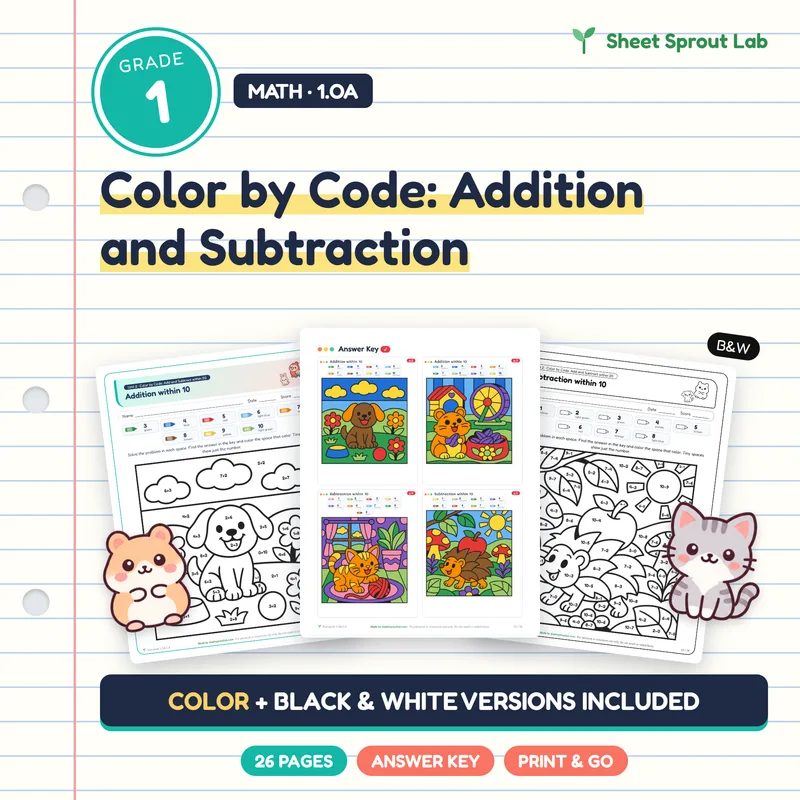
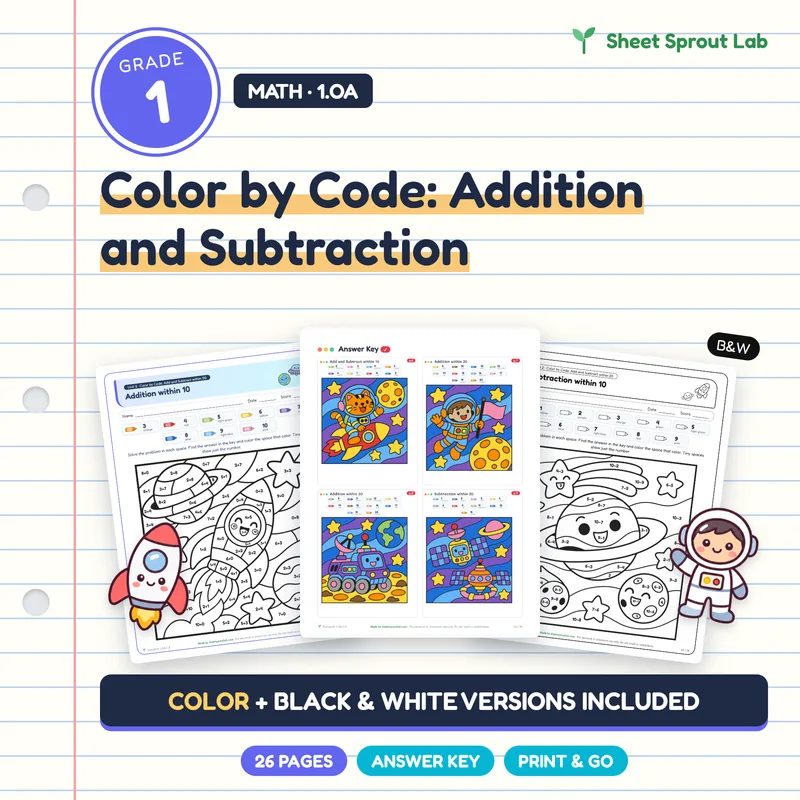
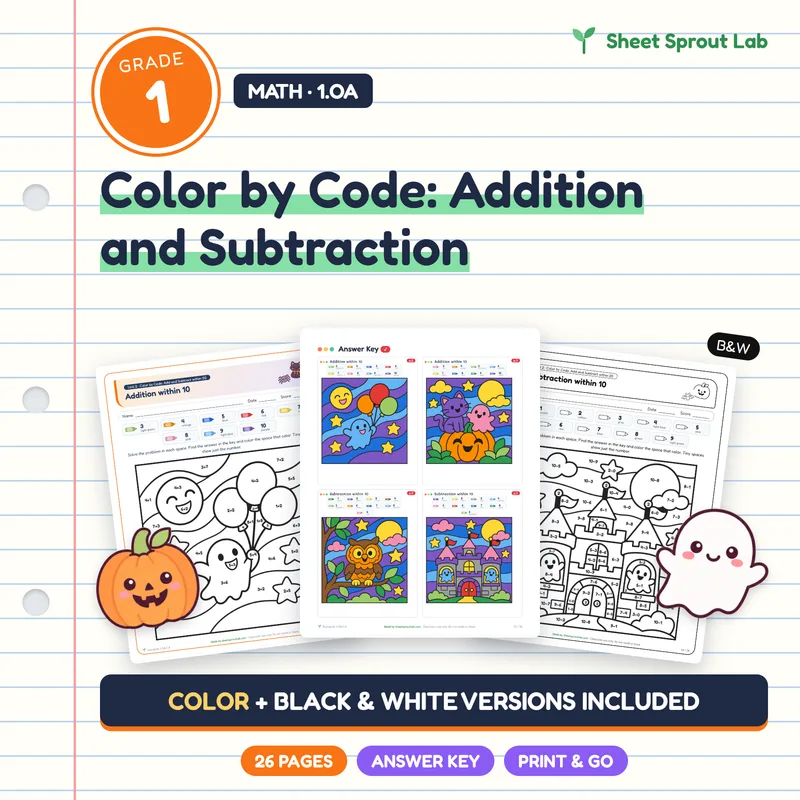
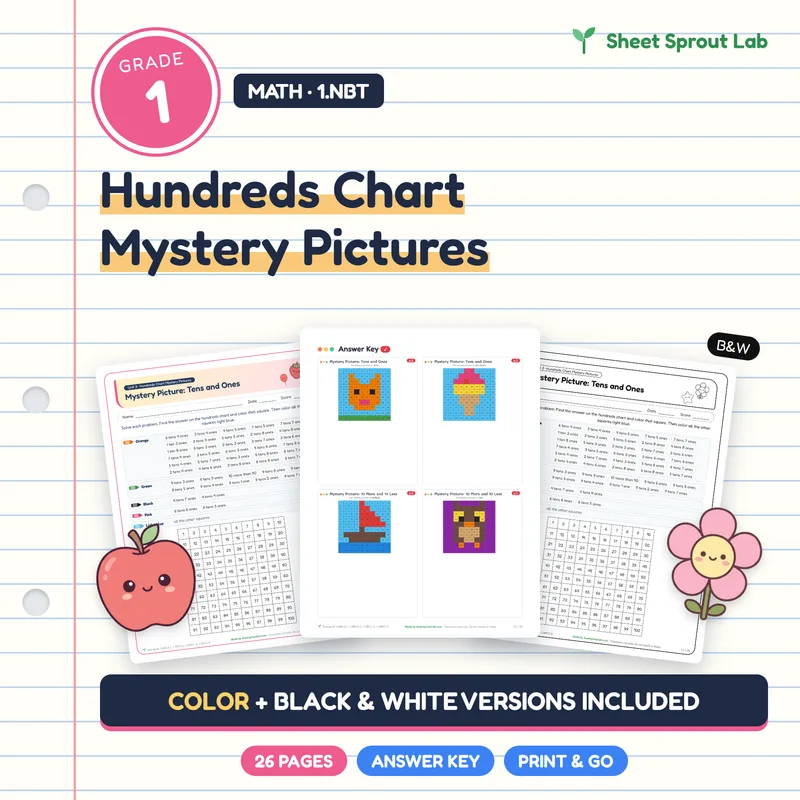
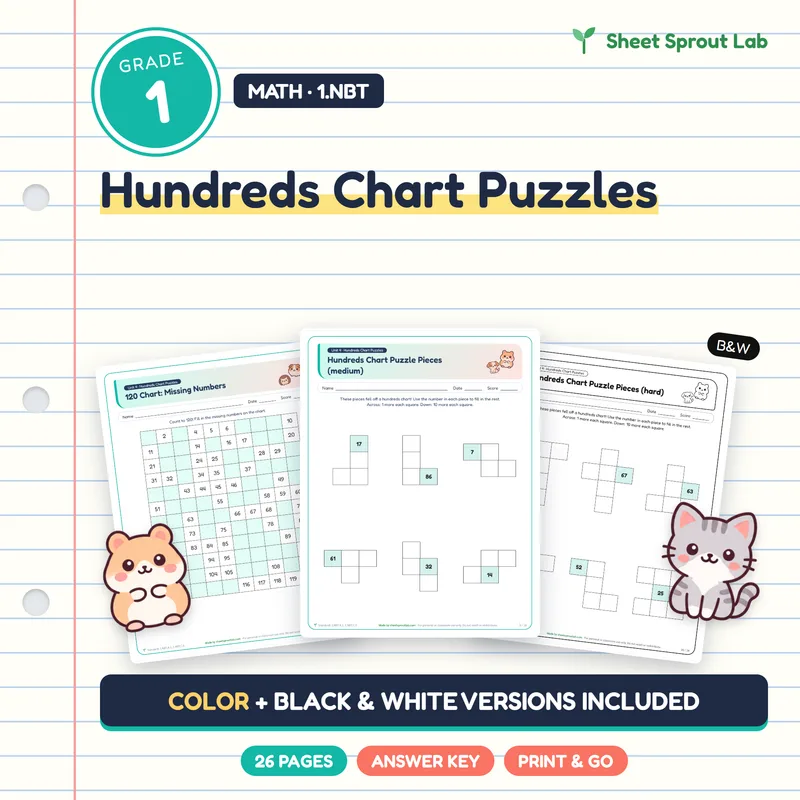
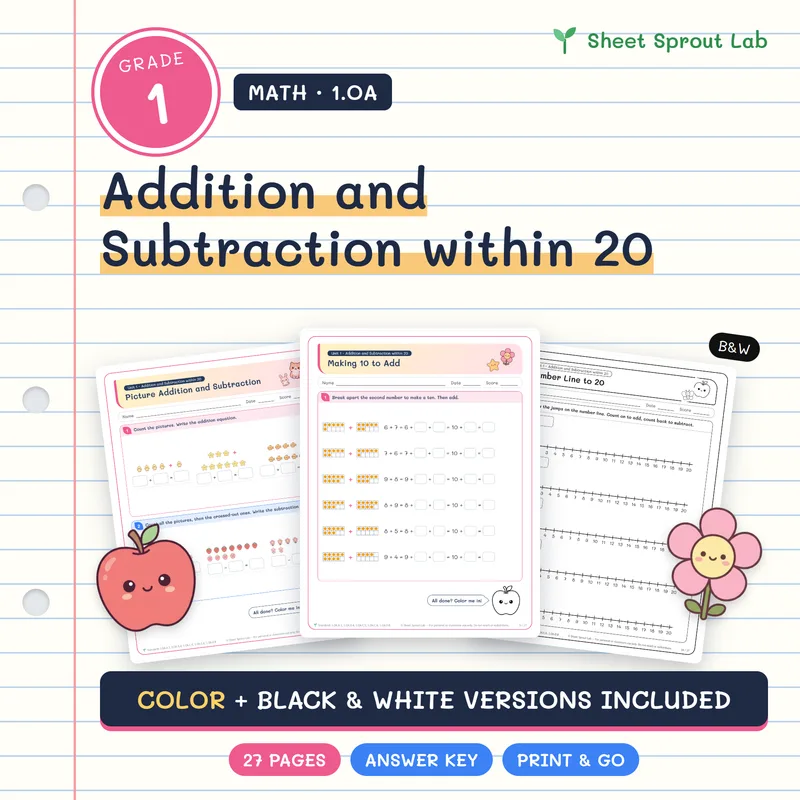
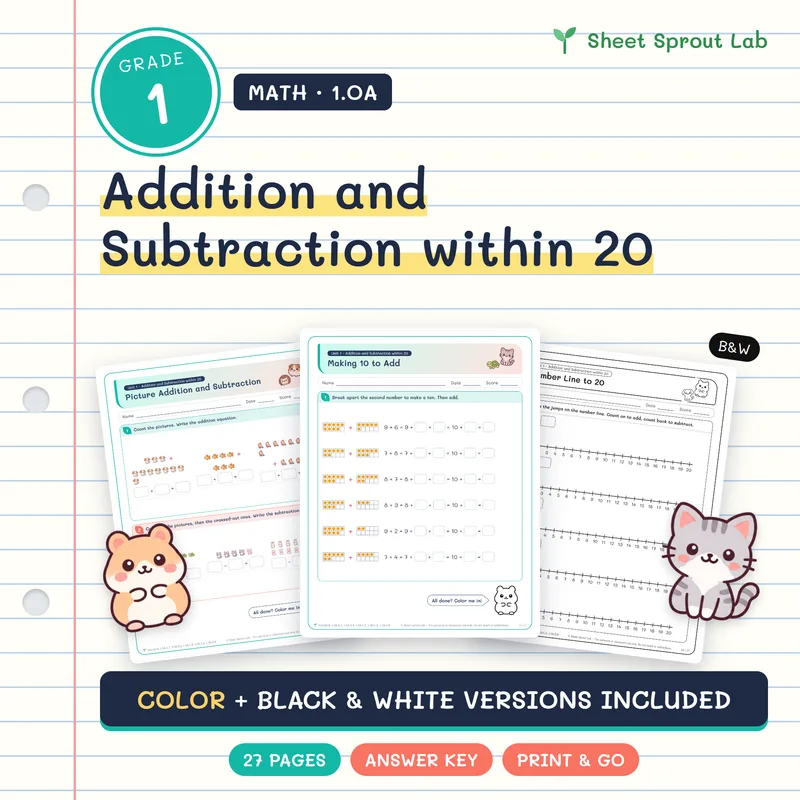
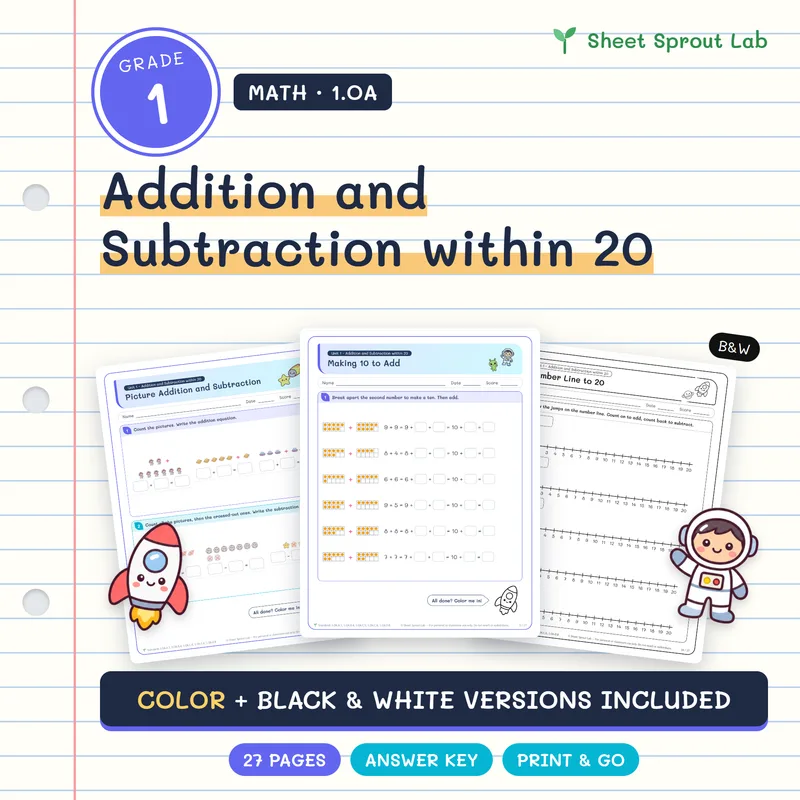
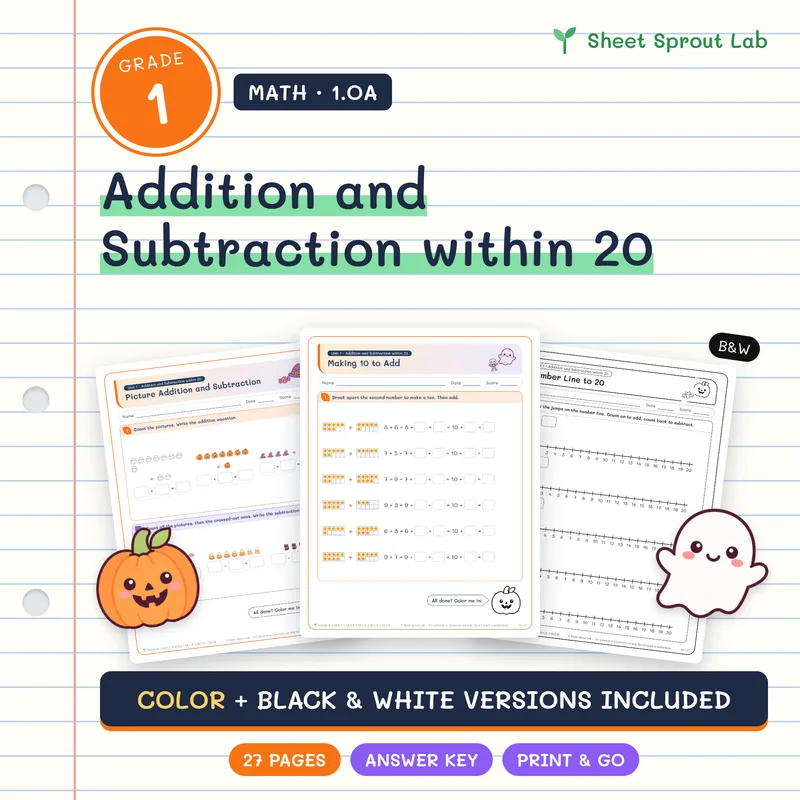
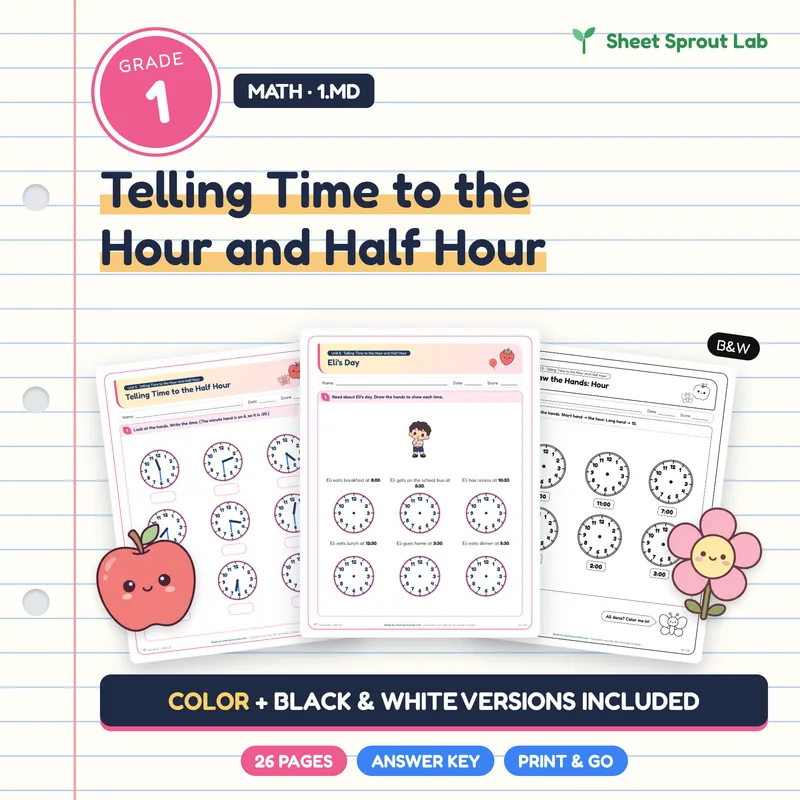
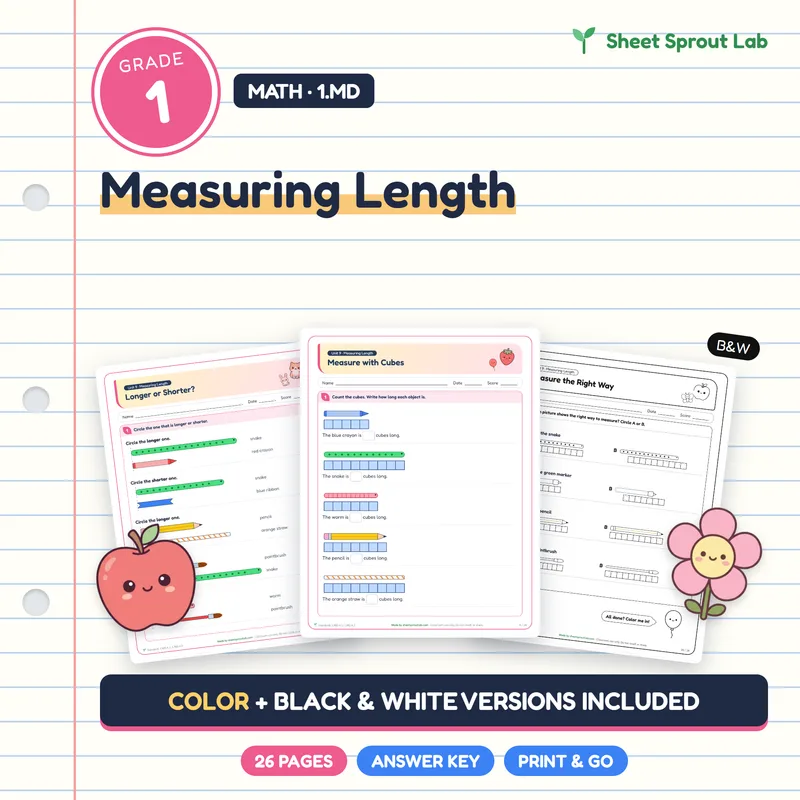
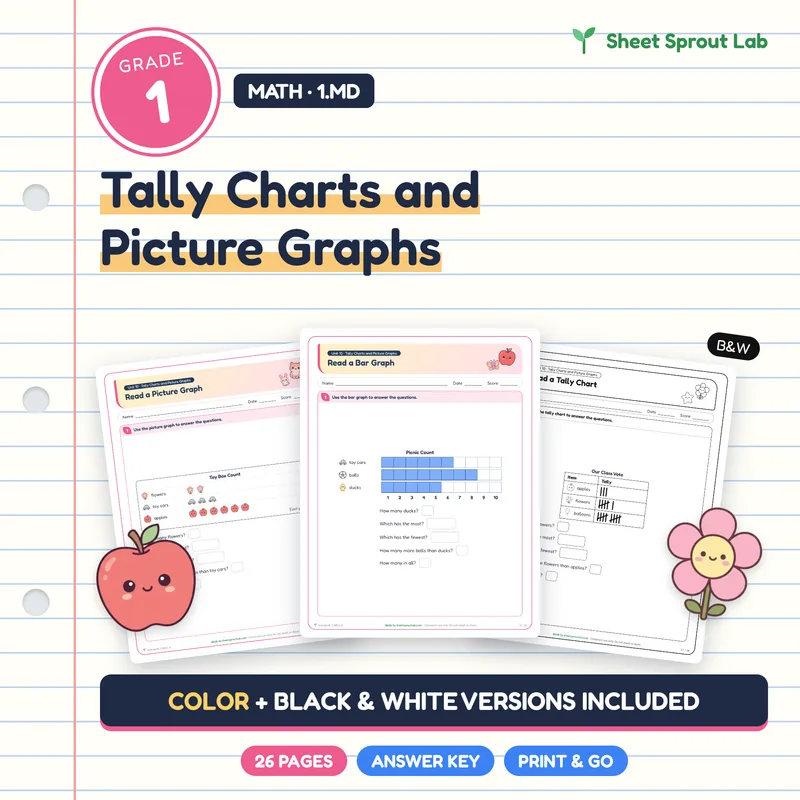
First grade math worksheets that match the Common Core: addition and subtraction within 20, place value and the hundreds chart, time and measurement. Every set comes in color and black & white with an answer key.
15 sets · every set has a free sample to print today
What first graders learn in math
First grade math is about making numbers make sense. Kids move from counting objects one by one to adding and subtracting within 20 with real strategies, they learn that the digits in 34 mean 3 tens and 4 ones, and they start to measure, tell time and read simple graphs.
The Common Core groups first grade math into four areas: Operations & Algebraic Thinking (adding and subtracting), Number & Operations in Base Ten (place value), Measurement & Data, and Geometry. Our worksheets are sorted the same way, and every set lists the exact standard it practices.
Skills kids practice
- Add and subtract within 20, and know the facts within 10 by heart
- Solve word problems with a missing number in any spot
- Count, read and write numbers to 120
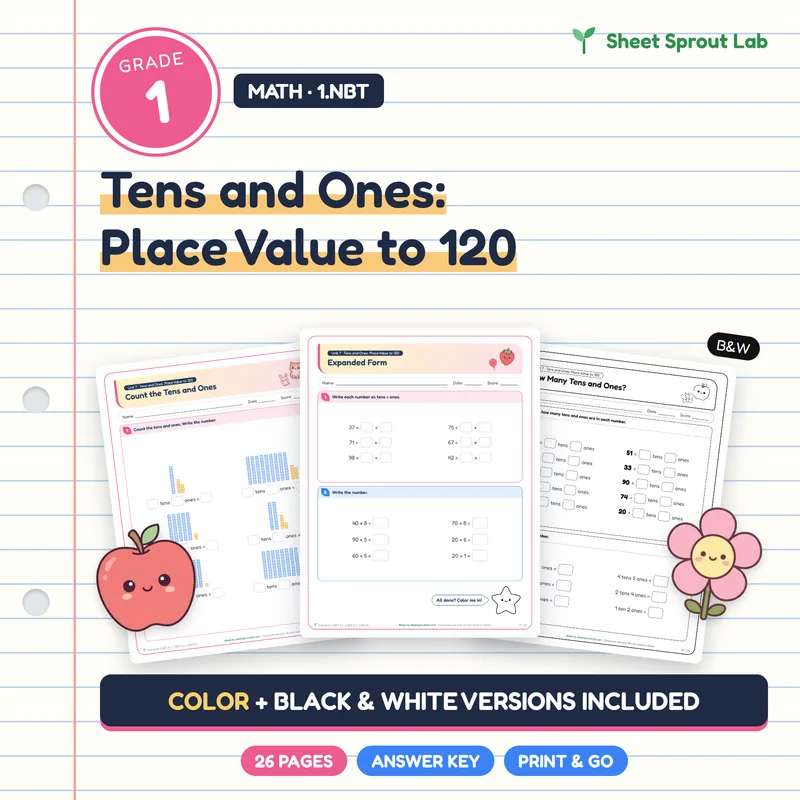
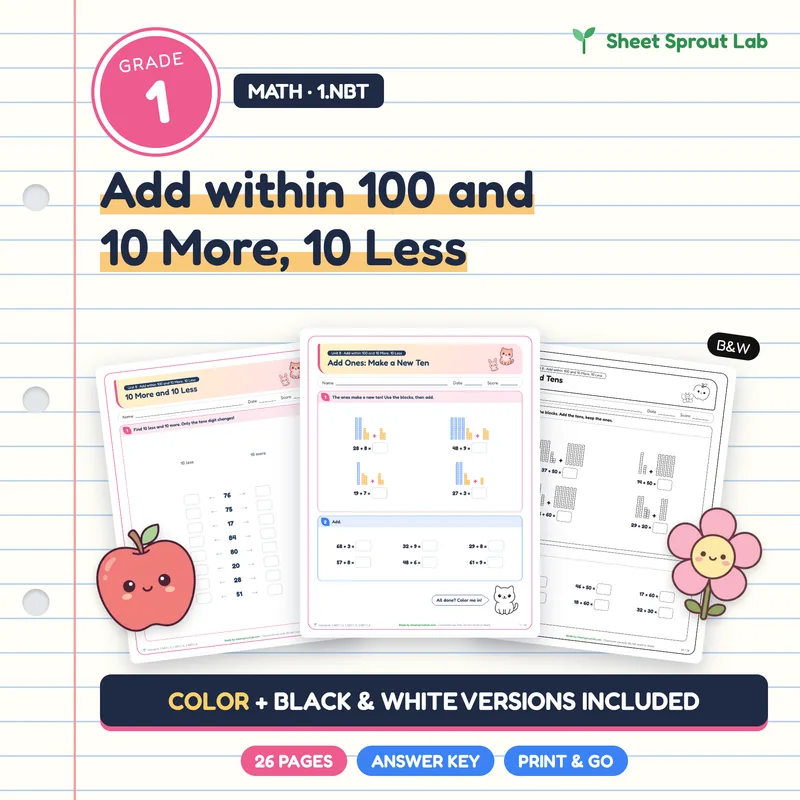
- Understand tens and ones, and find 10 more or 10 less
- Tell and write time to the hour and half hour
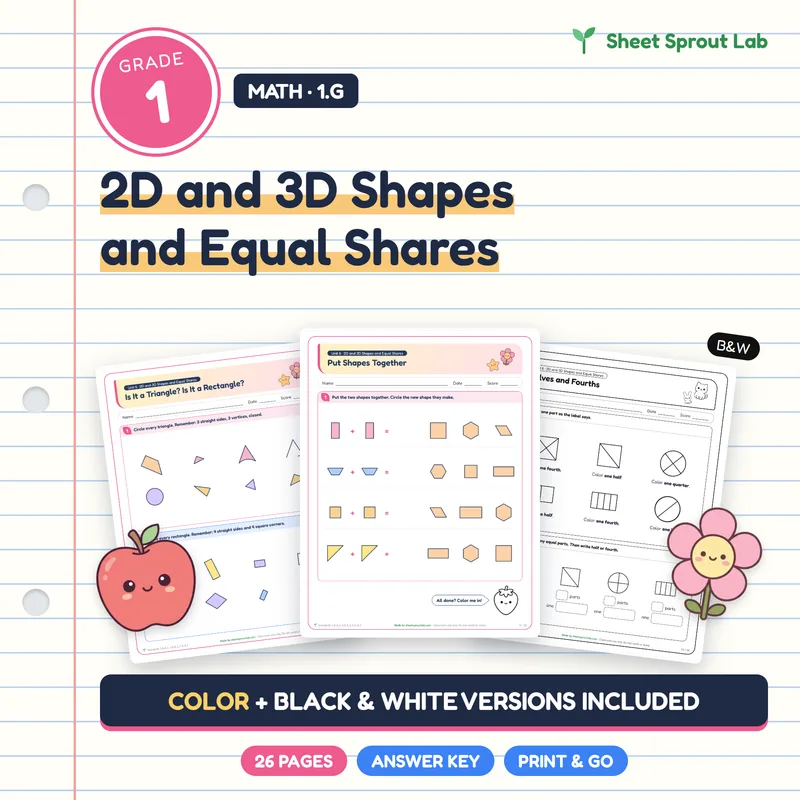
- Name shapes by their attributes and split them into halves and fourths
Tips for teachers and parents
- Short and often beats long: one worksheet a day keeps facts fresh without tears.
- Let kids use tools — ten frames, a number line, their fingers. Strategies come before speed.
- Print the black & white version for homework and save the color pages for centers or a fun Friday.
Questions about math worksheets
What math should a first grader know by the end of the year?
By the end of first grade most kids add and subtract within 20, know the facts within 10 quickly, count to 120, understand tens and ones in a two-digit number, and tell time to the hour and half hour.
Are these worksheets aligned to the Common Core?
Yes. Each set lists its Common Core standard on the product page and at the bottom of every worksheet.
Do the worksheets have answer keys?
Every set includes an answer key at the end of the PDF, and every worksheet comes in color and in black & white.
Standards covered
- 1.G.A.1 Distinguish between defining attributes (e.g., triangles are closed and three-sided) versus non-defining attributes (e.g., color, orientation, overall size); build and draw shapes to possess defining attributes.
- 1.G.A.2 Compose two-dimensional shapes (rectangles, squares, trapezoids, triangles, half-circles, and quarter-circles) or three-dimensional shapes (cubes, right rectangular prisms, right circular cones, and right circular cylinders) to create a composite shape, and compose new shapes from the composite shape.
- 1.G.A.3 Partition circles and rectangles into two and four equal shares, describe the shares using the words halves, fourths, and quarters, and use the phrases half of, fourth of, and quarter of. Describe the whole as two of, or four of the shares. Understand for these examples that decomposing into more equal shares creates smaller shares.
- 1.MD.A.1 Order three objects by length; compare the lengths of two objects indirectly by using a third object.
- 1.MD.A.2 Express the length of an object as a whole number of length units, by laying multiple copies of a shorter object (the length unit) end to end; understand that the length measurement of an object is the number of same-size length units that span it with no gaps or overlaps.
- 1.MD.B.3 Tell and write time in hours and half-hours using analog and digital clocks.
- 1.MD.C.4 Organize, represent, and interpret data with up to three categories; ask and answer questions about the total number of data points, how many in each category, and how many more or less are in one category than in another.
- 1.NBT.A.1 Count to 120, starting at any number less than 120. In this range, read and write numerals and represent a number of objects with a written numeral.
- 1.NBT.B.2 Understand that the two digits of a two-digit number represent amounts of tens and ones.
- 1.NBT.B.3 Compare two two-digit numbers based on meanings of the tens and ones digits, recording the results of comparisons with the symbols >, =, and <.
- 1.NBT.C.4 Add within 100, including adding a two-digit number and a one-digit number, and adding a two-digit number and a multiple of 10.
- 1.NBT.C.5 Given a two-digit number, mentally find 10 more or 10 less than the number, without having to count.
- 1.NBT.C.6 Subtract multiples of 10 in the range 10-90 from multiples of 10 in the range 10-90 (positive or zero differences), using concrete models or drawings and strategies based on place value, properties of operations, and/or the relationship between addition and subtraction; relate the strategy to a written method and explain the reasoning used.
- 1.OA.A.1 Use addition and subtraction within 20 to solve word problems involving situations of adding to, taking from, putting together, taking apart, and comparing, with unknowns in all positions.
- 1.OA.B.4 Understand subtraction as an unknown-addend problem.
- 1.OA.C.5 Relate counting to addition and subtraction (e.g., by counting on 2 to add 2).
- 1.OA.C.6 Add and subtract within 20, demonstrating fluency for addition and subtraction within 10. Use strategies such as counting on; making ten; decomposing a number leading to a ten; using the relationship between addition and subtraction; and creating equivalent but easier or known sums (e.g., doubles plus one).
- 1.OA.D.8 Determine the unknown whole number in an addition or subtraction equation relating three whole numbers.