Free worksheets / Kindergarten math / Place Value & Hundreds Chart
Kindergarten place value & hundreds chart worksheets
Place value and hundreds chart worksheets: count to 120, find 10 more and 10 less, and see how tens and ones build a number. Mystery pictures and puzzles make the practice feel like a game.
2 sets · free worksheets to print today for every set
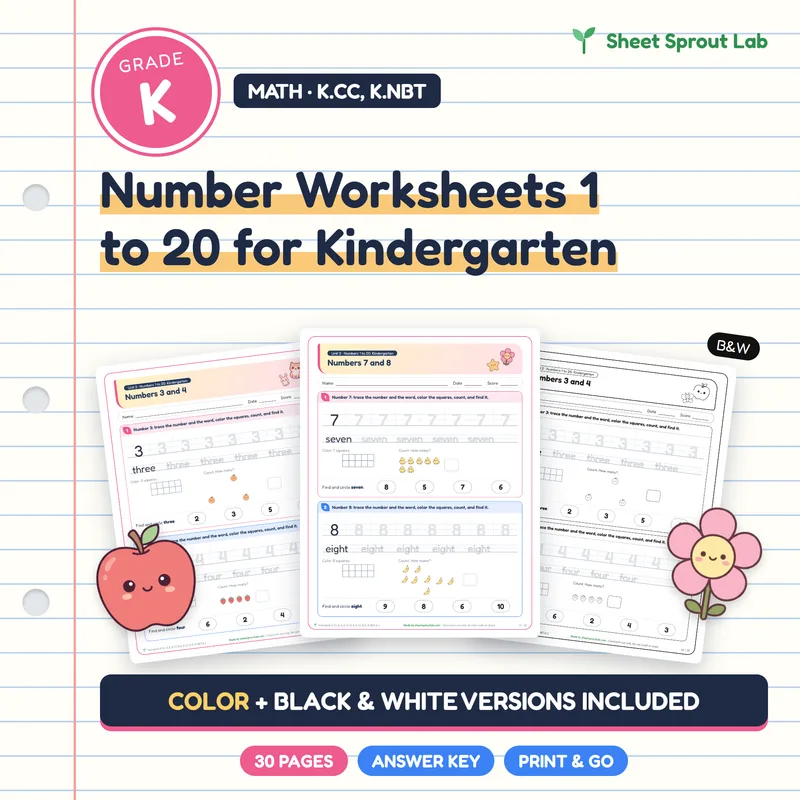
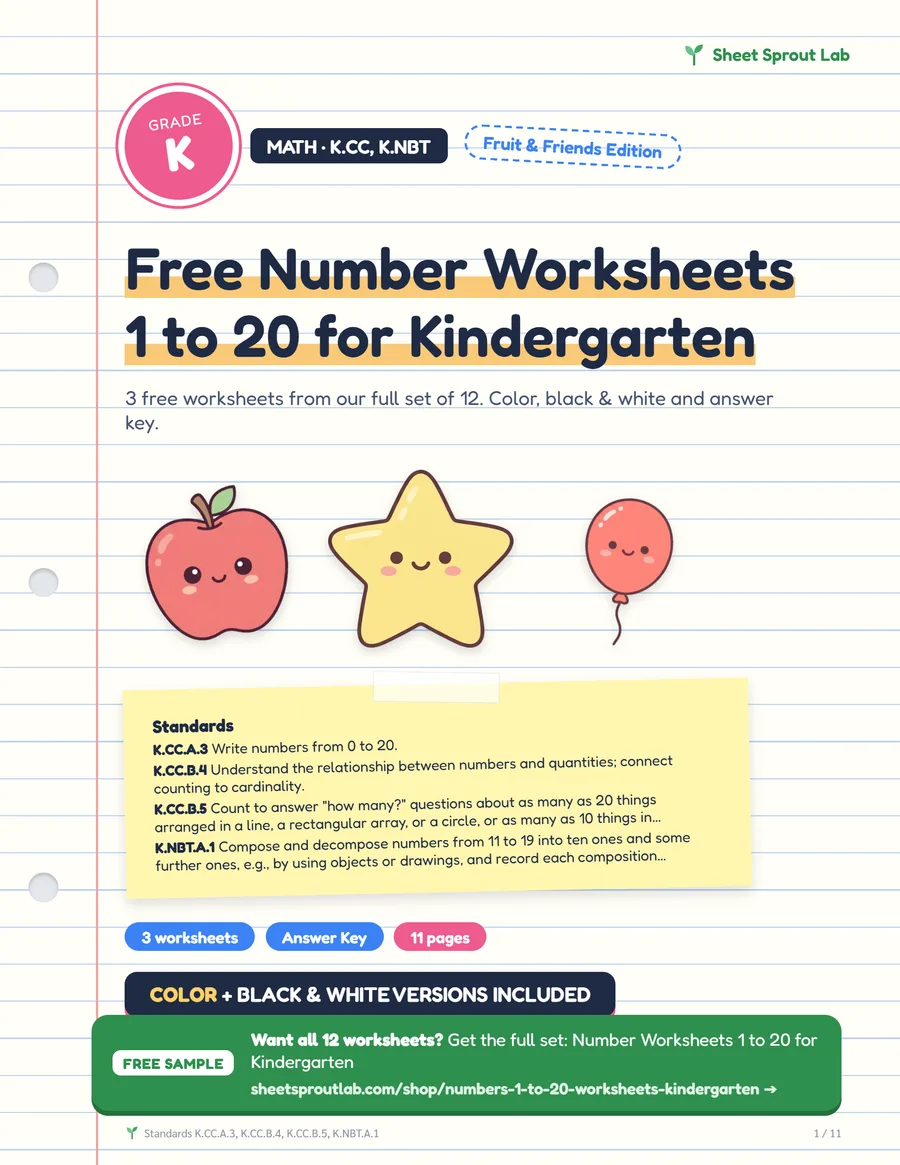
Teen numbers and early place value in kindergarten
The first big place value idea in kindergarten is that the teen numbers, 11 to 19, are a ten and some more ones. 14 is 10 and 4, and 18 is 10 and 8. Seeing that pattern early makes two-digit numbers in first grade much less mysterious.
Kids build these numbers with ten frames, counters and drawings, then record them as simple equations such as 13 = 10 + 3. The aim is understanding, not speed.
Skills kids practice
- Break teen numbers into a ten and some ones (K.NBT.A.1)
- Show a teen number with ten frames or drawings
- Write an equation like 16 = 10 + 6 (K.NBT.A.1)
- Count objects up to 20 and write the number (K.CC.B.5, K.CC.A.3)
Tips for teachers and parents
- Use a ten frame: fill the whole frame first, then add the extra ones beside it.
- Say the number two ways, "fourteen" and "ten and four", so the link sticks.
- Use two colors of counters, ten of one color and the rest of another, to make the ten stand out.
Questions about place value & hundreds chart worksheets
Do kindergartners learn place value?
They get a first look. Kindergarten covers only the teen numbers as a ten and some ones. Tens and ones in any two-digit number come in first grade.
Why do kids mix up teen numbers?
Names like thirteen and thirty sound alike, and the teens are said ones first. Building the number with a ten frame helps kids see which is which.
Standards covered
- K.CC.A.3 Write numbers from 0 to 20. Represent a number of objects with a written numeral 0-20 (with 0 representing a count of no objects).
- K.CC.B.4 Understand the relationship between numbers and quantities; connect counting to cardinality.
- K.CC.B.5 Count to answer "how many?" questions about as many as 20 things arranged in a line, a rectangular array, or a circle, or as many as 10 things in a scattered configuration; given a number from 1-20, count out that many objects.
- K.NBT.A.1 Compose and decompose numbers from 11 to 19 into ten ones and some further ones, e.g., by using objects or drawings, and record each composition or decomposition by a drawing or equation (e.g., 18 = 10 + 8); understand that these numbers are composed of ten ones and one, two, three, four, five, six, seven, eight, or nine ones.