Free worksheets / Second grade math / Addition, Subtraction & Word Problems
Second grade addition, subtraction & word problems worksheets
Addition and subtraction worksheets: count on, make a ten, doubles, fact families, missing addends and word problems within 20. Every set has color and black & white pages and an answer key, so they work for centers, morning work and homework.
4 sets · free worksheets to print today for every set
Addition, subtraction and arrays in second grade
This domain gets kids fluent with the basics so they can handle bigger numbers. Second graders know all sums of two one-digit numbers by memory and use mental strategies for facts within 20, like making a ten or using doubles. They also solve one- and two-step word problems within 100 where numbers are added, taken away, put together or compared.
It also lays the groundwork for multiplication. Kids sort numbers into even and odd, and build rectangular arrays of rows and columns and write the total as an addition equation, such as 3 + 3 + 3 + 3 = 12.
Skills kids practice
- Solve one- and two-step word problems within 100 (2.OA.A.1)
- Add and subtract within 20 with mental strategies (2.OA.B.2)
- Know sums of two one-digit numbers from memory (2.OA.B.2)
- Tell even from odd numbers up to 20 (2.OA.C.3)
- Write an even number as two equal addends, like 8 = 4 + 4 (2.OA.C.3)
- Build arrays up to 5 rows and 5 columns and write the total as repeated addition (2.OA.C.4)
Tips for teachers and parents
- Teach kids to draw a quick picture or bar for a word problem before solving it.
- Check even and odd by pairing up objects: if one is left over, the number is odd.
- Use egg cartons, muffin tins or a grid of stickers to build arrays at home.
Questions about addition, subtraction & word problems worksheets
How can I tell if a number is even or odd?
An even number can be split into pairs with none left over, and its last digit is 0, 2, 4, 6 or 8. An odd number always has one left over, and ends in 1, 3, 5, 7 or 9.
Do second graders learn multiplication?
Not formally. Arrays and equal groups prepare them for it, and multiplication itself starts in third grade.
What makes a word problem two-step?
It needs two operations to solve. For example, you add two amounts and then subtract what was used.
Standards covered
- 2.MD.B.5 Use addition and subtraction within 100 to solve word problems involving lengths that are given in the same units, e.g., by using drawings (such as drawings of rulers) and equations with a symbol for the unknown number to represent the problem.
- 2.MD.C.8 Solve word problems involving dollar bills, quarters, dimes, nickels, and pennies, using $ and ¢ symbols appropriately. Example: If you have 2 dimes and 3 pennies, how many cents do you have?
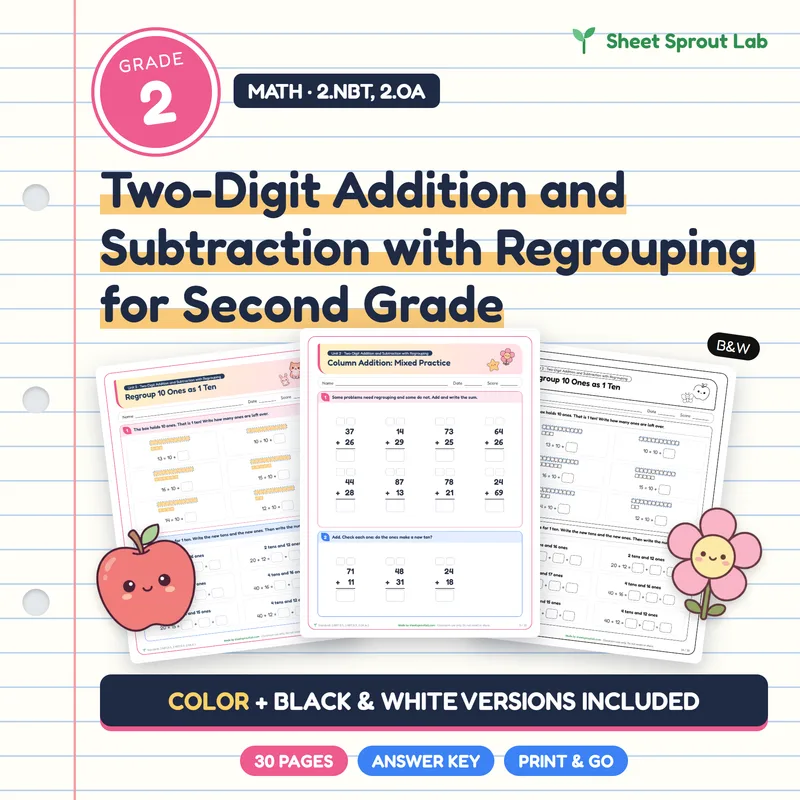
- 2.NBT.B.5 Fluently add and subtract within 100 using strategies based on place value, properties of operations, and/or the relationship between addition and subtraction.
- 2.NBT.B.9 Explain why addition and subtraction strategies work, using place value and the properties of operations. (Explanations may be supported by drawings or objects.)
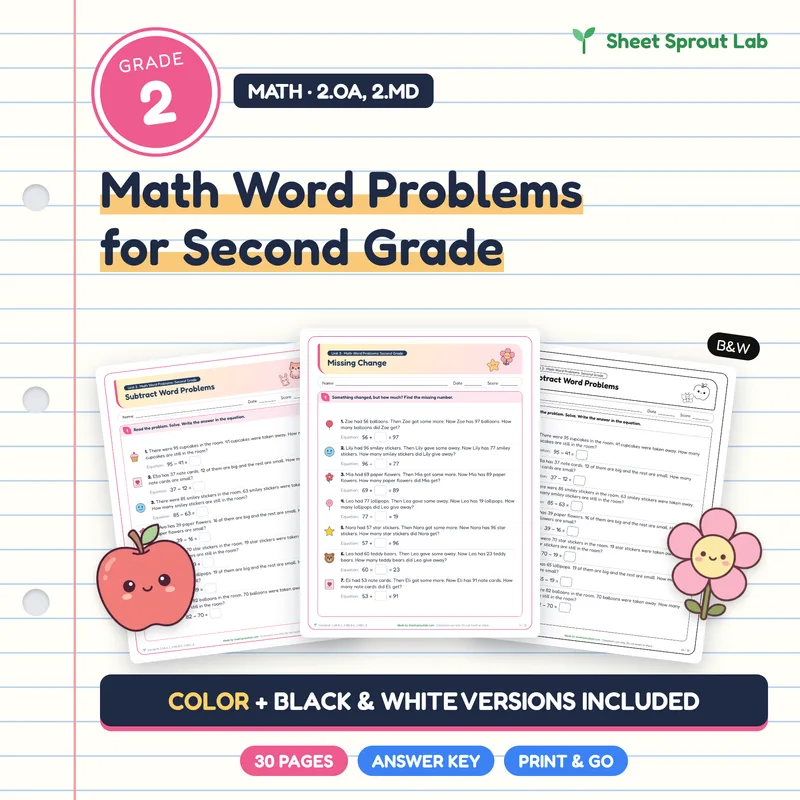
- 2.OA.A.1 Use addition and subtraction within 100 to solve one- and two-step word problems involving situations of adding to, taking from, putting together, taking apart, and comparing, with unknowns in all positions, e.g., by using drawings and equations with a symbol for the unknown number to represent the problem.